

When a face is no longer proof
AI can now rewrite what a person says, and how their lips move, during a live broadcast. This article explains why financial trust must move from “seeing” to “proving”, and why RevoAI is ready for that shift.
One patent filing, one big question for finance
On 29 October 2026, Microsoft’s patent application US 2026/0341309 A1 was published. It describes an AI system that changes what a live-stream speaker says within seconds, then redraws their lip movements to match. Because edits follow each viewer’s profile, two people watching the same broadcast could hear two different versions.
The filing’s main purposes are benign: live translation into the viewer’s language, removing filler words, filtering inappropriate language, with the original recording kept as a reference. But the capability itself does not care about intent. When real-time reconstruction of faces and voices appears in a leading company’s patent filing, the question for finance is direct:
Our answer: not on their own. The processes most directly exposed are remote verification: video-based customer onboarding (eKYC), confirming instructions by call, voice authorisation, or an executive “appearing” on screen to approve a transaction.
Three problems usually treated as one
To find the right solution, we must separate three questions every financial system has to answer before a transaction. Each needs a different tool.
Biometrics answer only part of the second question, and that is exactly the part AI is attacking. They cannot answer the other two. That is why “adding one more layer of face recognition” does not solve the problem of the AI era.
Can be simulated
Fake faces, voices and video are ever more convincing; anti-spoofing is always racing, always one step behind.
Cannot be changed once leaked
A leaked password can be changed; a leaked face cannot. The more biometric data is centralised, the more risk accumulates.
Recognition is not authority
Knowing who someone is says nothing about their legal eligibility, financial capacity or authority to transact.
Zero-Knowledge: prove what matters, nothing more
A Zero-Knowledge Proof is a cryptographic technique that lets one party prove a statement is true without revealing the data behind it. Combined with Predicate Verification, the receiving party gets exactly the conclusion it needs: pass or fail.
| Requirement | Traditional way | With Zero-Knowledge |
|---|---|---|
| Aged 18+ | Show date of birth, documents | Prove age ≥ 18 |
| Is a valid party | Reveal identity details | Prove membership of the permitted group |
| Has enough assets | Reveal account balance | Prove assets ≥ threshold |
| Qualifies for a loan | Submit the full file | Prove credit conditions are met |
| May transact | Cross-check much personal data | Prove authorisation conditions hold |
Say a company applies for a USD 100,000 loan. Instead of sending every statement, its transaction history and its representative’s personal file, it generates a proof that its assets meet the threshold, its cash flow qualifies, its credit score is above the bar and it is not on a restricted list. The lender verifies the proof in seconds without ever holding the raw data.
Biometrics: the right step for today, not the destination
Since 1 July 2024, under Decision 2345/QĐ-NHNN, every online transfer above VND 10 million per transaction or VND 20 million per day must be verified biometrically. The State Bank of Vietnam reports that the rule has significantly reduced account-takeover fraud. It was the right and effective step.
But attack technology does not stand still. Once real-time reconstruction of faces, voices and lip movements becomes common, biometrics will no longer be enough as the sole proof for high-value transactions. The next step is to shift the weight onto cryptographic proof: biometrics move back to unlocking the device, while the decision to allow a transaction rests on digital keys and verifiable proof.
The legal framework is opening the way too. The Personal Data Protection Law (Law No. 91/2025/QH15), in force since 1 January 2026, emphasises collecting only the data that is necessary. Zero-Knowledge turns that principle into mathematics: a recipient cannot misuse data it never held. With the VNeID national e-ID and the national credit information system as attestation sources, Vietnam is well placed to move straight to the next generation of verification.
RevoAI is ready for this shift
For RevoAI, Zero-Knowledge is not a research project. The six core technology capabilities of the RevoAIx platform are complete and ready to deploy now, with Zero-Knowledge verification working alongside the other five on one shared technology core.
Data canonicalisation
Brings data from many sources into one standard, ready for attestation and verification.
Explainable AI
Every AI conclusion comes with reasoning and evidence that can be checked.
Digital twin
A digital model of assets, companies and customers for continuous assessment and monitoring.
Zero-Knowledge verification
Proves identity, eligibility and authority without revealing raw data.
Cryptographic audit
Every decision and transaction is cryptographically committed: tamper-evident and always verifiable.
AI agent execution
AI agents act within delegated limits and leave a verifiable trail.
Mapped to the three problems in part 02: cryptographic audit answers is this content real; digital keys with attestation answer is it the right person; Zero-Knowledge verification answers are they qualified and authorised. All three run in one architecture:
Raw data stays at the source or on the owner’s device; only proofs and verification results move. The solution is delivered via API and integrates with existing bank and enterprise systems without replacing infrastructure. Biometrics keep running in parallel until the cryptographic proof layer takes over the main role.
Three fields to apply it now
Banking & Fintech
Verify loan eligibility, financial capacity, identity and transaction rights without collecting the whole file, in the spirit of data minimisation under the Personal Data Protection Law.
Real & digital assets
Automatically check each transaction’s compliance conditions: the parties’ legal eligibility, transfer restrictions and each market’s own rules.
AI & digital identity
When AI agents transact on people’s behalf, every action must prove who delegated it, what is allowed, the limit and whether it is still in force.
The third will soon matter most. Once AI agents start signing, paying and managing assets, the question is not only “who owns this AI” but “was this transaction within the mandate”. Zero-Knowledge verification together with agentic execution answers that with proof, not with images or voices.
The age of proof
Microsoft’s filing is not yet a commercial product. But it shows clearly where technology is heading: the line between real and generated images is disappearing. When faces, voices and video can all be rebuilt in real time, trust in finance must rest on mathematics and cryptography.
Face ID will not disappear. It will return to its proper place: the key that unlocks a device. The decision to allow a transaction will belong to proof. RevoAI is ready for that shift.
Don’t reveal everything. Prove what matters.
Sources: Patent application US 2026/0341309 A1 (Microsoft Technology Licensing, LLC), published 29 October 2026; Decision 2345/QĐ-NHNN of the State Bank of Vietnam, 18 December 2023; Personal Data Protection Law No. 91/2025/QH15. Diagrams illustrate principles.
More news
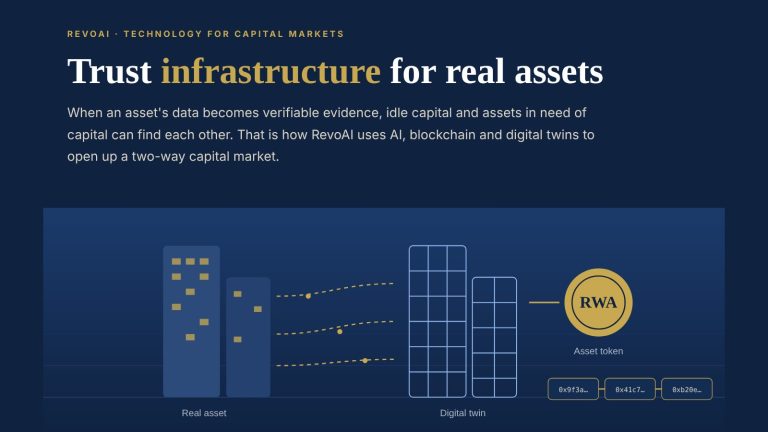
Trust Infrastructure for Real Assets
When an asset's data becomes verifiable evidence, idle capital and assets in need of capital can find each other. That…
Read more →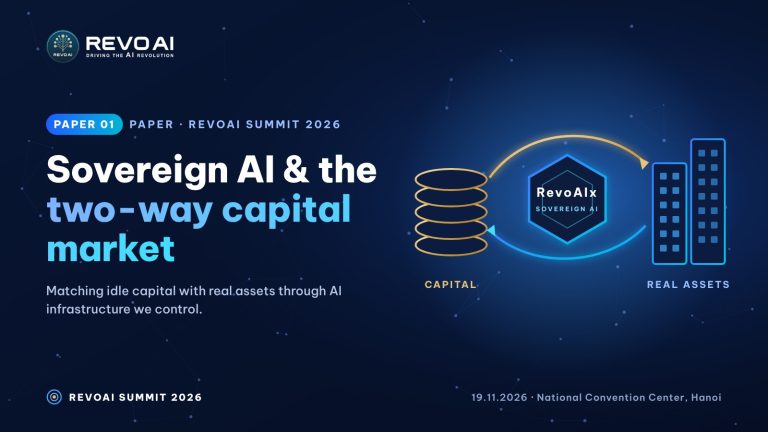
Sovereign AI Infrastructure and the Two-Way Capital Market
The nation that can match idle capital with real assets through AI infrastructure it controls will attract the largest pool…
Read more →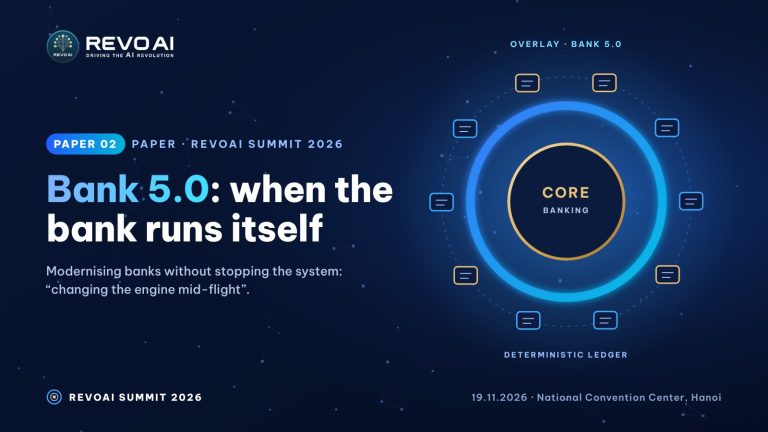
Bank 5.0: When the Bank Runs Itself
Modernising a bank used to be a high-risk decision: replacing the core system was like transplanting the heart of a…
Read more →